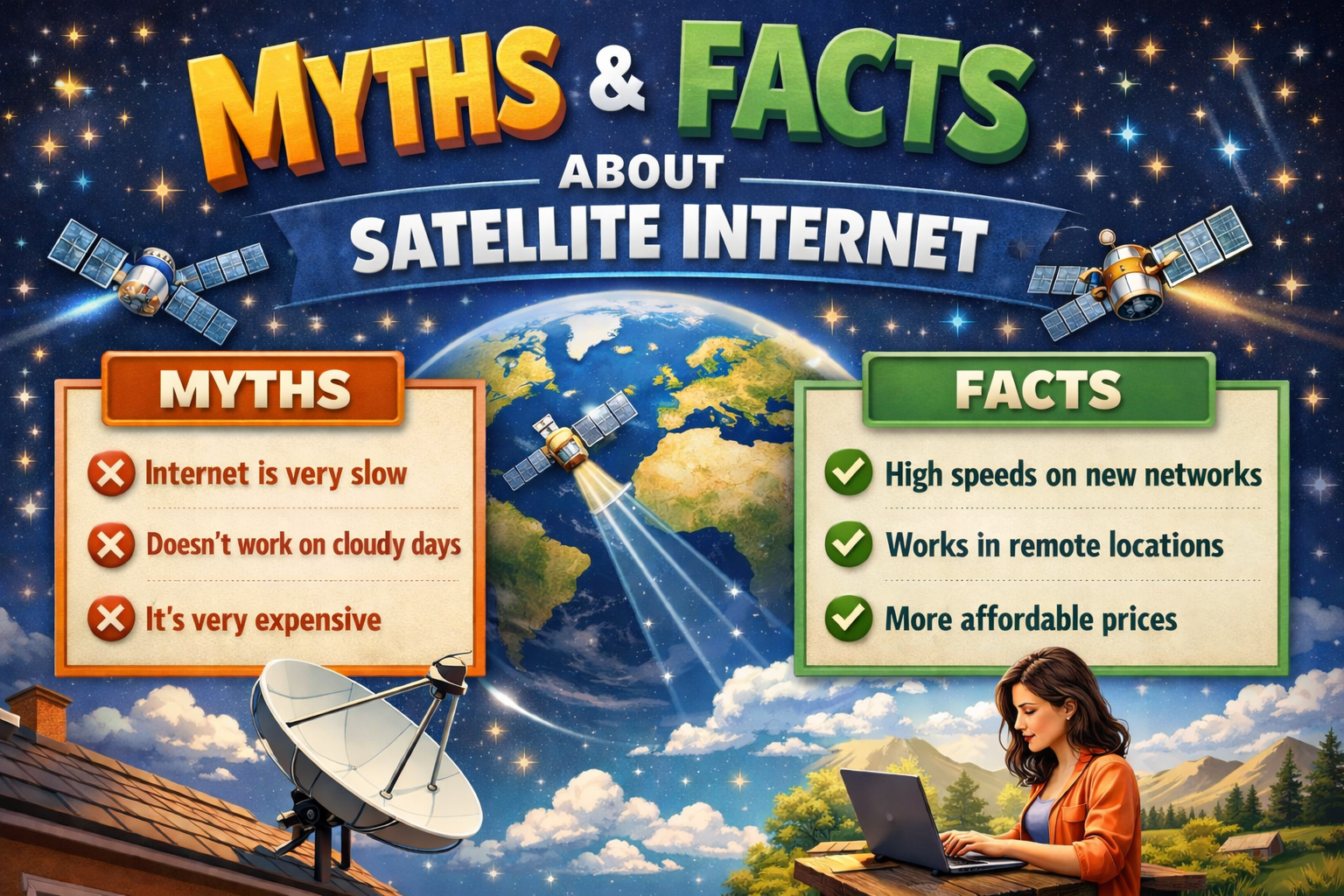
Satellite internet has been surrounded by misconceptions and outdated assumptions that persist despite dramatic technological improvements in recent years. Many people’s understanding of satellite internet remains frozen in the era of early geostationary systems from the 1990s and 2000s, when the technology was expensive, slow, and plagued by significant limitations. Today’s satellite internet, particularly newer low Earth orbit constellations, bears little resemblance to those legacy systems. This comprehensive examination separates persistent myths from current realities, providing accurate information to help consumers, businesses, and policymakers make informed decisions about satellite connectivity.
Myth: Satellite Internet Is Always Slow
Perhaps the most pervasive myth about satellite internet is that it inevitably delivers slow speeds inadequate for modern internet usage. This belief stems from experiences with older geostationary satellite systems that typically offered speeds measured in single-digit megabits per second.
The truth is that modern satellite internet can deliver speeds competitive with many terrestrial broadband options. Contemporary low Earth orbit satellite services routinely provide download speeds between 100 and 200 megabits per second, with some systems exceeding 300 megabits per second in optimal conditions. These speeds far surpass minimum broadband definitions and prove more than adequate for streaming high-definition video, video conferencing, online gaming, and typical household internet usage.
Upload speeds, traditionally a weakness of satellite systems, have also improved substantially. While modern satellite internet upload speeds typically range from 10 to 40 megabits per second, somewhat slower than download speeds, they exceed what many DSL and older cable connections provide. These upload rates support video conferencing, cloud file synchronization, and other upload-intensive applications effectively.
The speed limitation myth persists partly because some traditional geostationary satellite services remain in operation with legacy technology offering slower speeds. Consumers researching satellite internet may encounter information about these older systems alongside modern services, creating confusion. Additionally, satellite internet speeds can vary based on network congestion, weather conditions, and user location, leading some users to experience slower speeds than advertised maximums.
Understanding that satellite internet speed varies by provider, technology generation, and service plan is essential. Blanket statements that satellite internet is universally slow ignore the dramatic technological progress that has occurred and continues accelerating.
Myth: Latency Makes Satellite Internet Unusable
Latency, the delay between sending a request and receiving a response, has historically represented satellite internet’s most significant limitation. Legacy geostationary satellites positioned 22,000 miles above Earth created unavoidable round-trip signal delays of 500 to 700 milliseconds, making real-time applications like video calls frustratingly laggy.
The truth is that modern low Earth orbit satellite constellations have largely solved the latency problem. By positioning satellites just 300 to 900 miles above Earth’s surface, these systems achieve latency between 20 and 40 milliseconds, comparable to many cable and DSL connections. This latency range feels responsive for virtually all applications including video conferencing, VoIP calls, web browsing, and even most online gaming.
While satellite internet latency still exceeds fiber connections that can achieve sub-10 millisecond latency, the difference matters only for extremely latency-sensitive applications. Professional esports gaming requiring millisecond-level response times may notice the difference, but typical users find modern satellite latency completely acceptable for daily internet activities.
The latency myth persists because many people’s satellite internet experiences come from older technology or secondhand accounts from years past. Additionally, the physics-based inevitability of signal travel time over vast distances makes latency sound like an insurmountable problem, even though reducing satellite altitude effectively addresses it.
Context matters when evaluating latency. A 30-millisecond satellite connection may have higher latency than 10-millisecond fiber but far lower latency than 100-millisecond international terrestrial routes or overloaded cable networks. Latency represents one factor among many affecting internet experience, not an automatic disqualifier.
Myth: Weather Always Disrupts Satellite Internet
The belief that rain or snow immediately causes satellite internet outages represents another persistent myth. While weather can indeed affect satellite signals, the relationship is more nuanced than commonly believed.
The truth is that moderate weather conditions have minimal impact on modern satellite internet. Light to moderate rain, typical cloudy conditions, and even moderate snow generally do not disrupt service noticeably. Satellite systems incorporate error correction, adaptive coding, and link budget margins that maintain connectivity through most weather conditions.
Heavy rain, dense storm clouds, or significant snow accumulation can degrade satellite signals, potentially reducing speeds or briefly interrupting service during severe conditions. However, these weather-related outages typically last only for the duration of the most intense precipitation directly overhead, often minutes rather than hours. Once storms pass, service returns to normal immediately without requiring manual intervention.
The severity of weather impact varies by frequency band. Higher frequency bands used by some satellite services are more susceptible to rain attenuation than lower frequencies, creating performance differences between systems. User terminal design also affects weather resilience, with larger antennas and more powerful amplifiers better able to maintain links during adverse conditions.
Snow accumulation on satellite dishes can block signals entirely, requiring periodic clearing in heavy snow regions. However, many modern user terminals include heating elements that automatically melt snow, minimizing manual maintenance requirements. Proper installation ensuring adequate dish angle for snow shedding also reduces accumulation problems.
Comparing satellite internet weather vulnerability to terrestrial alternatives provides perspective. While satellite signals may be affected by severe weather overhead, terrestrial infrastructure can be damaged by storms, requiring days or weeks for repairs. Satellite systems often recover faster from weather events than damaged physical infrastructure.
Myth: Data Caps Make Satellite Internet Impractical
Many people believe that restrictive data caps inevitably accompany satellite internet, making it unsuitable for typical household usage involving streaming, downloads, and multiple users.
The truth is that data policies vary enormously across satellite internet providers and plans. While some satellite services do impose monthly data caps, others offer unlimited data plans similar to terrestrial broadband options. Even plans with caps often provide sufficient data for typical usage, with limits frequently set at 100 gigabytes or more monthly.
Unlimited satellite internet plans have become increasingly common as satellite technology advances and capacity increases. These plans may include network management policies that temporarily reduce speeds during peak congestion for heavy users, but they do not impose hard caps that cut off service or charge overage fees when thresholds are exceeded.
Understanding typical data consumption helps evaluate whether capped plans meet individual needs. Streaming high-definition video consumes approximately 3 gigabytes per hour, meaning a 100-gigabyte monthly cap supports over 30 hours of HD streaming plus typical web browsing, email, and other usage. Many households find this adequate, though heavy streaming families may prefer unlimited plans.
The data cap concern often stems from experiences with older satellite systems or cellular data plans with restrictive caps measured in single-digit gigabytes. Modern satellite internet data allowances typically far exceed these historical limits, making caps less constraining than commonly assumed.
Comparing satellite data policies to terrestrial alternatives reveals that caps are not unique to satellite services. Many cable and DSL providers also impose data caps or throttle heavy users, making this concern applicable across technologies rather than specific to satellite internet.
Myth: Satellite Internet Costs Prohibitively More Than Alternatives
The perception that satellite internet always costs far more than terrestrial options prevents many people from considering it seriously. This belief has historical roots in early satellite services that charged premium prices for limited performance.
The truth is that modern satellite internet pricing has become increasingly competitive with terrestrial broadband, especially in rural markets. Monthly service fees for residential satellite internet typically range from 100 to 150 dollars, comparable to premium cable or fiber plans in many markets. While basic DSL might cost less in some areas, satellite internet prices fall within the range of what many consumers already pay for quality broadband.
Equipment costs represent a more significant upfront investment for satellite internet compared to terrestrial services. User terminals typically cost 500 to 600 dollars for residential service, substantially more than cable modem rental fees. However, this one-time cost amortizes over years of service, and some providers offer payment plans reducing initial outlays.
Total cost of ownership comparisons must account for alternatives actually available in specific locations. For rural areas where the only alternative to satellite is slow DSL at 50 dollars monthly, satellite internet does cost more. However, for areas where alternatives are limited to overpriced, low-quality fixed wireless or cellular hotspots, satellite pricing becomes competitive while delivering superior performance.
Value considerations extend beyond raw price to include performance, reliability, and capabilities enabled by connectivity. A household that can maintain remote work, access online education, or operate a home business due to satellite internet may find the service pays for itself through opportunities that inadequate connectivity would prevent.
The cost myth also fails to account for ongoing price decreases in satellite internet. Competition among providers and technological advances continue driving prices down while performance improves, making satellite internet an increasingly attractive value proposition even compared to terrestrial options.
Myth: Satellite Internet Cannot Support Gaming
The belief that online gaming is impossible or extremely frustrating on satellite internet stems from latency concerns and experiences with older systems. Many assume that satellite delays make competitive gaming unplayable.
The truth is more nuanced. Modern low Earth orbit satellite internet with latency around 25 to 35 milliseconds supports many types of online gaming quite well. Turn-based games, strategy games, role-playing games, and less latency-sensitive titles play smoothly on satellite connections. Even some action games that are not ultra-competitive work acceptably.
Highly competitive fast-paced games where millisecond differences matter, such as professional esports titles or first-person shooters at high skill levels, do remain challenging on satellite internet. The 25-plus millisecond latency, while much better than legacy satellite systems, still exceeds the sub-20 millisecond latency serious competitive players prefer. However, this limitation affects a relatively small subset of games and players.
Casual gamers playing for enjoyment rather than professional competition generally find modern satellite internet entirely adequate for their gaming. The experience differs little from gaming on cable or DSL connections with similar latency characteristics. Download speeds sufficient for updating and downloading games further enable satellite internet gaming.
Context matters significantly. A casual gamer in a rural area choosing between satellite internet gaming and no online gaming at all finds satellite perfectly satisfactory. A professional esports player competing at the highest levels might notice latency disadvantages compared to fiber connections, but this represents a specialized use case rather than typical gaming.
The gaming myth also overlooks that many internet activities gamers value beyond actual gameplay work excellently on satellite internet including streaming gaming content, downloading games, participating in gaming communities, and watching esports broadcasts.
Myth: Installation Is Complicated and Expensive
Many people assume that installing satellite internet requires expensive professional installation, lengthy waiting periods, and complex technical work comparable to installing rooftop satellite television dishes.
The truth is that many modern satellite internet systems are designed for self-installation by customers with no technical expertise. User terminals arrive with detailed instructions and mobile apps that guide users through installation step-by-step, from finding appropriate mounting locations to positioning terminals for optimal satellite visibility.
Self-installation typically requires no more than placing the terminal in an appropriate location with clear sky visibility, connecting power and network cables, and allowing the terminal to automatically orient and acquire satellite signals. The entire process often takes less than an hour and requires only basic abilities to follow instructions and connect cables.
Professional installation remains available for customers who prefer it or have complex installation requirements, but it is optional for most residential users rather than mandatory. Professional installation costs vary but typically add a few hundred dollars to initial setup costs. For straightforward installations, self-installation saves this expense while providing equally good results.
Installation speed represents another advantage of modern satellite internet. Once terminals arrive, installation and activation can occur within hours, compared to terrestrial services that may require scheduling technician visits weeks in advance and coordinating infrastructure deployment. This rapid installation particularly benefits people moving to new locations or needing connectivity urgently.
The complexity myth likely stems from traditional satellite television installations requiring careful antenna alignment and technical adjustments. Modern internet satellite terminals use phased array antennas that automatically point and optimize themselves, eliminating manual alignment requirements that complicated older systems.
Myth: Satellite Internet Harms the Night Sky Irreparably
Environmental concerns about satellite internet, particularly regarding light pollution and astronomical observation, represent legitimate considerations that have generated significant discussion. However, the concern is sometimes stated in absolutist terms suggesting satellite constellations inevitably destroy astronomical observation permanently.
The truth involves ongoing challenges but also substantial mitigation efforts. Satellite operators have worked with astronomical communities to develop dark satellite coatings, sun visors, and operational practices that reduce satellite brightness significantly compared to early deployments. While satellites remain visible under certain conditions, their impact on professional astronomy has been reduced through these efforts.
The concern about satellite visibility applies primarily to satellites illuminated by sunlight shortly after dusk and before dawn when satellites are in sunlight while observers are in darkness. During middle-of-night hours when serious astronomical observation typically occurs, satellites are in Earth’s shadow and invisible. The impact window is narrower than sometimes suggested.
Amateur stargazing experiences mixed impacts. Casual stargazers may notice satellite trains crossing the sky, particularly shortly after large deployment events. However, the experience of viewing stars, planets, and deep sky objects remains essentially unchanged for most observers in most locations. Light pollution from terrestrial sources remains a far greater impediment to stargazing than satellites.
The astronomical concern represents an important consideration requiring ongoing attention and mitigation efforts, but it does not justify dismissing satellite internet’s substantial benefits for global connectivity. Balancing different societal priorities through technological improvements and operational practices offers path forward rather than abandoning satellite internet entirely.
Truth: Satellite Internet Enables Remote Work and Education
Moving beyond myth-busting to affirm genuine truths, satellite internet’s transformative impact on remote work and education opportunities represents one of its most significant benefits.
Satellite internet enables professional remote work in locations previously impossible for knowledge workers. People can now live in rural areas, small towns, or other desirable locations while maintaining careers requiring video conferencing, cloud application access, and reliable internet connectivity. This flexibility improves quality of life while enabling economic activity in underserved regions.
Educational opportunities expand dramatically with satellite internet access. Students in rural schools access online learning resources, virtual classrooms, and educational content previously unavailable. Distance education programs become viable for people in remote locations. Educational equity improves as geographic location becomes less determinative of educational access.
Telemedicine enabled by satellite internet brings healthcare access to remote populations. Video consultations with specialists, remote monitoring of chronic conditions, and access to medical information improve health outcomes for rural populations who previously faced long journeys for medical care.
The truth of satellite internet’s enabling power contradicts myths suggesting the technology remains too limited for meaningful applications. Modern satellite internet genuinely transforms possibilities for people and communities previously excluded from digital opportunities.
Truth: Technology Continues Improving Rapidly
Another important truth is that satellite internet technology is not static but continues advancing rapidly. Current limitations are not permanent constraints but temporary factors that ongoing development addresses.
Next-generation satellites being developed and launched offer higher capacities, improved performance, and better efficiency than current systems. Technology that seems cutting-edge today will be surpassed by more advanced systems within years. This rapid progress means evaluations of satellite internet must account for improvement trajectories rather than treating current capabilities as fixed ceilings.
Competition among multiple satellite internet providers drives continuous improvement. No provider can remain complacent when competitors are deploying better technology and offering superior service. This competitive dynamic benefits consumers through falling prices and improving performance.
Integration between satellite and terrestrial networks creates hybrid systems that leverage advantages of both technologies. Future connectivity solutions may seamlessly transition between satellite and terrestrial connections based on location, cost, and performance requirements, providing optimal connectivity in all situations.
Moving Beyond Outdated Assumptions
Many myths about satellite internet stem from outdated information, experiences with legacy technology, or oversimplified understanding of complex systems. The reality of modern satellite internet is far more positive than these myths suggest, though it is not without genuine limitations that users should understand.
Satellite internet today delivers speeds comparable to quality terrestrial broadband, latency suitable for virtually all typical applications, weather resilience that maintains service through most conditions, data policies ranging from capped to unlimited, pricing competitive with alternatives in many markets, gaming support for most titles and players, installation simplicity through self-service options, and environmental impacts being actively mitigated through technological and operational improvements.
Understanding these truths enables better decision-making for consumers evaluating connectivity options, businesses planning network infrastructure, and policymakers developing programs to expand internet access. Satellite internet represents a genuine solution to connectivity challenges, not a second-rate alternative to be considered only when nothing else is available.
As technology continues advancing and constellations expand, satellite internet’s capabilities will only improve further. The myths that limited its perception in the past become increasingly divorced from reality with each technological generation. Judging satellite internet based on current capabilities rather than historical limitations or persistent myths reveals a technology that has matured into a viable, valuable connectivity option for millions of people worldwide.

Edward Cullen is a technology writer focused on satellite internet and space-based connectivity. He shares clear, practical insights to help readers understand how modern space technology is transforming internet access, especially in remote and underserved areas.