
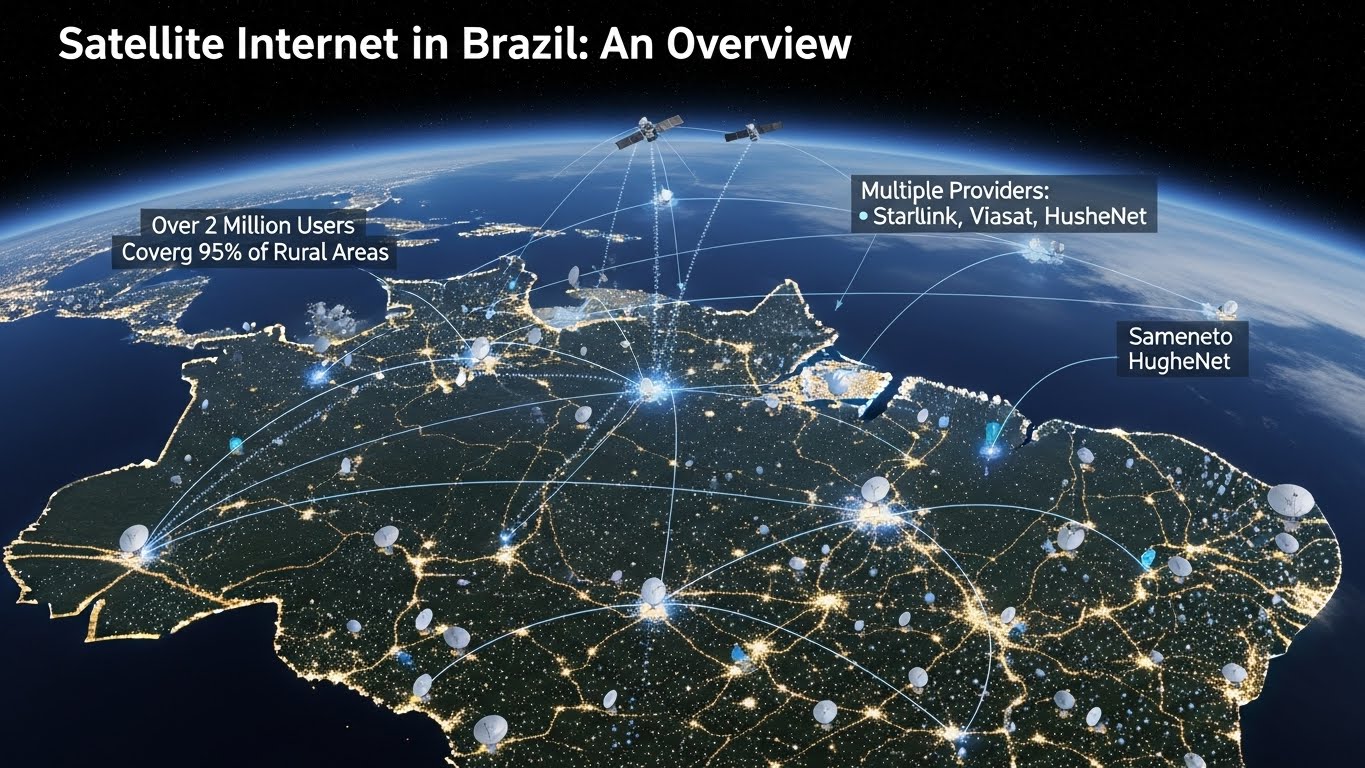
The digital landscape in Brazil is a study of contrasts. While coastal metropolises enjoy fiber-optic speeds that rival any global capital, the vast interior—spanning the Amazon rainforest, the Cerrado, and expansive agricultural hubs—has historically struggled with connectivity. This geographical challenge has positioned satellite internet not just as a luxury, but as a critical infrastructure pillar for Brazil’s economic and social development.
In this article, we explore the current state of satellite internet in Brazil, the major players, the technological shifts from GEO to LEO orbits, and what the future holds for connectivity in South America’s largest nation.
1. The Geographical Necessity for Satellite Connectivity
Brazil is the fifth-largest country in the world by landmass. Its territory includes dense rainforests, semi-arid regions, and mountain ranges where laying fiber-optic cables is either environmentally impossible or economically unviable.
For millions of Brazilians living in “silent zones,” satellite technology is the only gateway to:
- Agribusiness: Monitoring crops and managing machinery via IoT.
- Education: Accessing distance learning in remote riverside communities.
- Government Services: Implementing “Digital Government” in distant municipalities.
- Public Safety: Enabling communication for border patrols and environmental agencies.
2. The Evolution of Satellite Orbits: GEO vs. LEO
To understand the current market, one must distinguish between the two primary technologies currently serving Brazil.
Geostationary Orbit (GEO)
Traditionally, satellite internet in Brazil relied on GEO satellites. These are positioned approximately $35,786$ kilometers above the Earth. Because they stay fixed over one point, they provide stable coverage but suffer from high latency (delay), often exceeding $600$ ms.
- Key Players: Viasat, HughesNet, and Telebras (SGDC).
Low Earth Orbit (LEO)
The “Starlink Revolution” introduced LEO satellites, which orbit at altitudes between $500$ km and $1,200$ km. This proximity reduces latency to $25$–$50$ ms, making activities like video conferencing and online gaming possible.
- Key Player: Starlink (SpaceX).
3. Major Providers in the Brazilian Market
Starlink (SpaceX)
Since its arrival in Brazil in 2022, Starlink has disrupted the market. By leveraging a massive constellation of LEO satellites, it offers speeds often exceeding $150$ Mbps. It has become the preferred choice for farmers in Mato Grosso and schools in the Amazon.
HughesNet
A veteran in the Brazilian market, HughesNet focuses on reliability and reaching the “deep interior.” While its speeds are lower than Starlink’s, its established local support and diverse plans make it a staple for rural households.
Viasat
Viasat operates through a strategic partnership with Telebras, utilizing the Geostationary Defense and Strategic Communications Satellite (SGDC-1). They focus heavily on government contracts and high-capacity residential plans.
Telebras
The state-owned company plays a sovereign role. Its SGDC satellite ensures that even the most remote military outposts and public schools have a secure, Brazilian-controlled connection.
4. The Impact on Brazilian Agribusiness
Agribusiness accounts for nearly 25% of Brazil’s GDP. However, the “connectivity gap” has long hindered the adoption of Precision Agriculture.
With satellite internet, Brazilian farmers are now implementing:
- Real-time Telemetry: Tractors and harvesters send performance data to the cloud.
- Climate Monitoring: Sensors provide hyper-local weather data to optimize planting.
- Logistics Tracking: Monitoring the fleet of trucks moving soy and corn across the country.
5. Regulatory Landscape: The Role of ANATEL
The National Telecommunications Agency (ANATEL) regulates the sector. For a satellite provider to operate in Brazil, it must obtain landing rights.
Recent regulatory trends in Brazil include:
- Simplification of Licensing: Reducing bureaucracy for LEO constellations.
- Spectrum Management: Ensuring that satellite signals do not interfere with the burgeoning 5G networks, especially in the 3.5 GHz band.
6. Challenges and Barriers to Adoption
Despite its growth, satellite internet faces significant hurdles in Brazil:
- Cost of Equipment: The initial investment for an antenna and router (especially for LEO services) can exceed a minimum wage salary.
- Taxation: Brazil has one of the highest tax burdens on telecommunications services in the world.
- Weather Interference: Heavy tropical rainfall can cause “rain fade,” a temporary degradation of the satellite signal, particularly on Ka-band frequencies.
7. The Future: Multi-Orbit Strategies and 5G Integration
The future of Brazilian connectivity is not a battle between fiber and satellite, but rather an integration of both.
The Rise of Direct-to-Cell
Companies like SpaceX and AST SpaceMobile are working on technology that allows standard smartphones to connect directly to satellites. This could eliminate “dead zones” for text messaging and emergency calls across the entire Brazilian territory.
5G Backhaul
Satellite technology is increasingly used as “backhaul” for 5G towers in rural towns. The satellite provides the data link to the core network, which the tower then broadcasts to local mobile users.
8. Comparative Analysis: Which Service to Choose?
| Feature | Starlink (LEO) | HughesNet/Viasat (GEO) |
| Average Speed | 100 – 250 Mbps | 10 – 50 Mbps |
| Latency | 25 – 60 ms | 600+ ms |
| Installation Cost | High | Low/Included |
| Best For | Gaming, Video Calls, High Demand | Basic Browsing, Email, Social Media |
| Portability | High (Mobile Kits) | Fixed |
Satellite internet has entered a “Golden Age” in Brazil. The transition from high-latency GEO satellites to high-speed LEO constellations has democratized access to the digital economy for those living outside major urban centers. As competition increases and hardware costs potentially decrease, we can expect the “digital divide” in Brazil to shrink significantly over the next decade.
For the Brazilian consumer, the choice now depends on their specific needs: those requiring high-speed interactivity will gravitate toward LEO providers, while those seeking established local presence and specialized rural plans may still find value in traditional GEO operators.