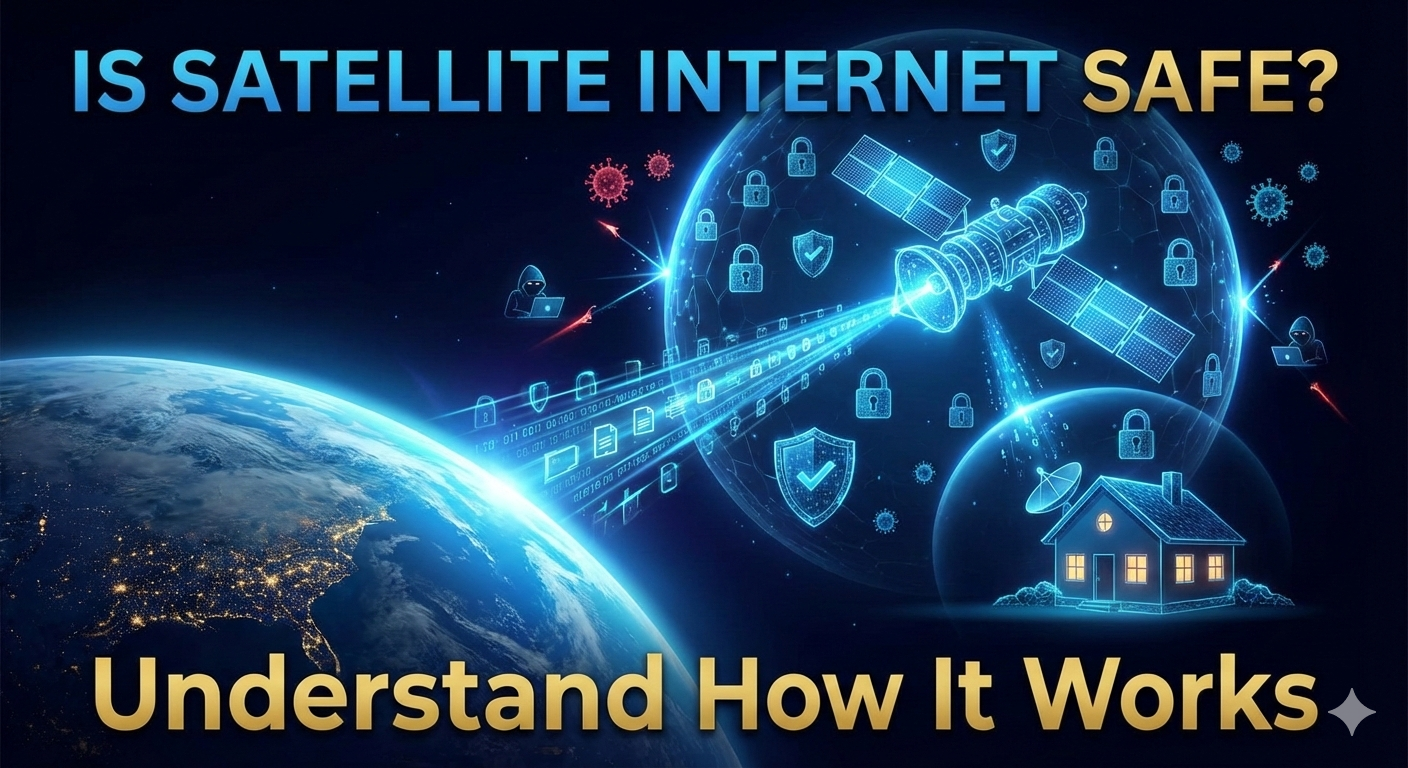
If you live in a rural area, a farm, or even a remote business location, you’ve probably asked yourself: is satellite internet safe? That’s a fair question. After all, your personal data, passwords, and even financial information travel through that connection every day. Let’s break this down in a simple, honest, and human way.
What Is Satellite Internet?
Satellite internet is a type of connection that uses communication satellites orbiting Earth to deliver internet access to users.
A Simple Definition
Instead of cables underground, your data travels through space. Sounds futuristic, right? 🚀
Where It’s Most Used
It’s widely used in rural areas, farms, remote communities, ships, airplanes, and places where fiber or cable simply can’t reach.
How Satellite Internet Works
Understanding how it works helps a lot when talking about security.
From Click to Satellite
When you click a website:
- The request goes from your device to a satellite dish
- The dish sends the signal to a satellite in orbit
- The satellite sends it to a ground station
- The data comes back the same way
All this happens in milliseconds.
The Role of Ground Stations
These stations act like internet gateways, connecting satellites to the global web.
Types of Satellites Used
Not all satellite internet is the same.
GEO Satellites
Geostationary satellites stay fixed relative to Earth. Traditional providers rely on them.
LEO Satellites
Low Earth Orbit satellites, used by companies like Starlink (SpaceX), are closer to Earth, offering lower latency and better performance.
Required Equipment
You don’t need a rocket scientist at home, but some gear is essential.
Satellite Dish
This antenna communicates directly with the satellite.
Modem and Router
They convert the signal into usable internet for your devices.
Is Satellite Internet Really Safe?
Short answer: yes, it is safe — when used correctly.
Data Protection Mechanisms
Modern satellite internet uses advanced encryption, similar to fiber and cable connections.
Real-World Security Standards
Providers follow international standards like AES encryption and secure authentication protocols.
Encryption and Privacy
This is where many people worry the most.
How Encryption Works
Your data is scrambled before being transmitted. Even if intercepted, it’s useless without the key.
Privacy Policies
Companies like Viasat, HughesNet, and Starlink have clear privacy policies explaining how data is handled:
Satellite Internet vs Fiber and Cable
Is it less secure than fiber? Not really.
Security Differences
All modern connections use similar security layers.
Performance Considerations
Satellite may have higher latency, but security-wise, they’re on the same level.
Main Advantages
Wide Coverage
Works where no other internet can.
Accessibility
Perfect for rural homes, farms, and remote businesses.
Main Disadvantages
Latency
Because signals travel to space, response time can be higher (especially with GEO satellites).
Weather Impact
Heavy rain can affect signal quality — known as rain fade.
Weather and Signal Stability
Rain Fade
Strong rain can weaken the signal temporarily.
How Providers Reduce It
Modern systems use adaptive power control and signal redundancy to minimize disruptions.
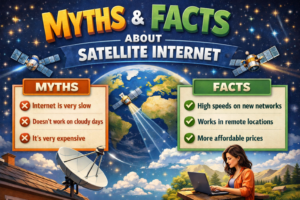
Common Myths About Satellite Internet Security
“It’s Easy to Hack”
❌ False. Encryption makes interception extremely difficult.
“Anyone Can Spy on the Signal”
❌ Another myth. Without decryption keys, data is unreadable.
Real Security Risks
Like any internet connection, risks exist — but mostly on the user side.
Network Vulnerabilities
Weak passwords and outdated firmware are the real problem.
User-Side Risks
Using public Wi-Fi habits at home? That’s more dangerous than the satellite itself.
Tips to Use Satellite Internet Safely
Secure Your Router
- Change default passwords
- Enable firewall
- Update firmware regularly
Good Digital Habits
- Use HTTPS websites
- Enable two-factor authentication
- Use a trusted VPN if needed
Is Satellite Internet Worth It Today?
For Rural Users
Absolutely. It can be life-changing.
For Businesses
Great for backup connections and remote operations.
The Future of Satellite Internet Security
New Technologies
AI-based monitoring and smarter encryption are already being deployed.
Leading Companies
Companies like SpaceX (Starlink), Amazon Project Kuiper, and OneWeb are pushing security forward.
So, is satellite internet safe? Yes — very safe when provided by reputable companies and used responsibly. It’s not some fragile, insecure technology floating in space. It’s a robust, encrypted, and constantly evolving solution that connects millions of people worldwide.
If you live where other connections fail, satellite internet isn’t just safe — it’s essential.

Edward Cullen is a technology writer focused on satellite internet and space-based connectivity. He shares clear, practical insights to help readers understand how modern space technology is transforming internet access, especially in remote and underserved areas.