In the early days of the Space Age, a satellite was essentially a lonely mirror in the sky. It would receive a signal from a ground station, amplify it, and beam it back down to another location on Earth. This “bent-pipe” architecture served us well for decades, but as our demand for global, high-speed, and low-latency data has exploded, the traditional model has hit a wall.
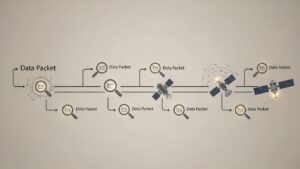
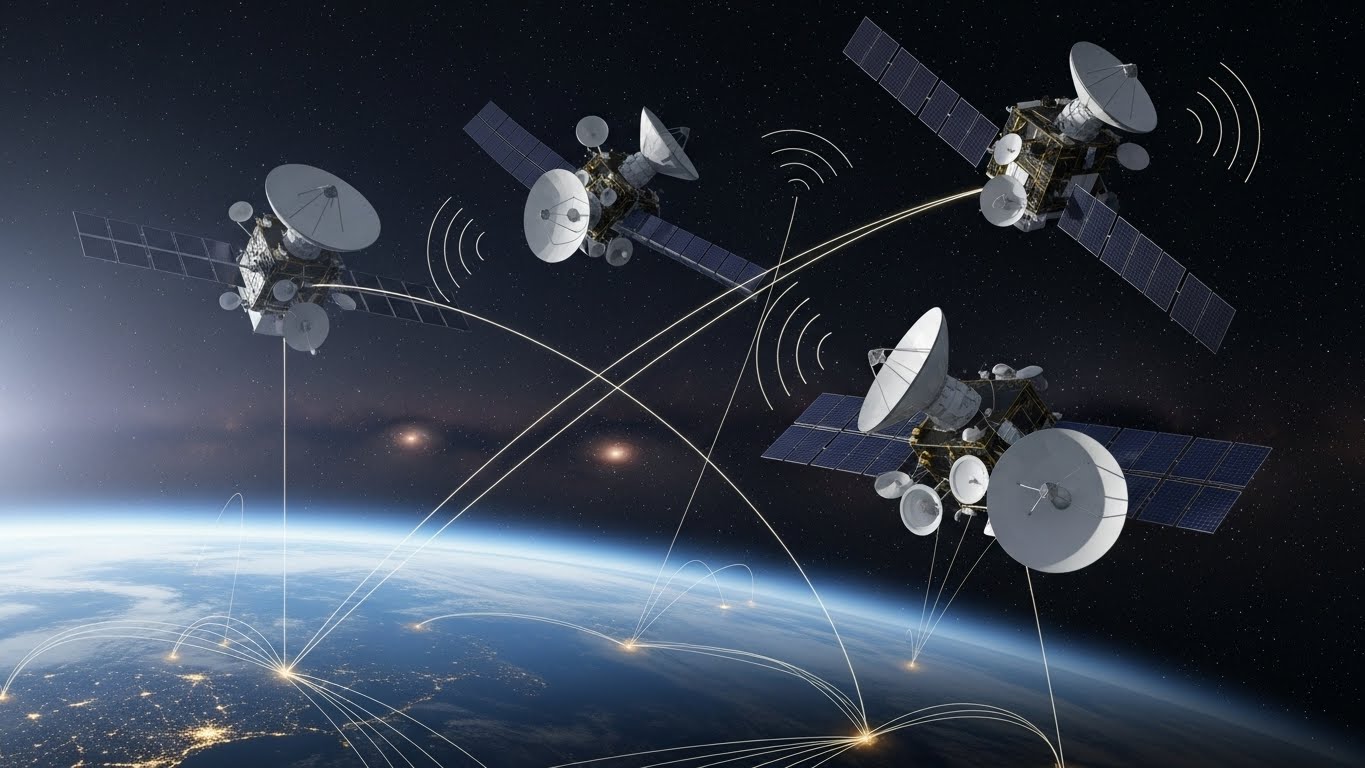
Today, we are witnessing the birth of the Orbital Mesh Network. No longer just isolated relay points, modern satellites are becoming part of a sophisticated, interconnected web in space. This evolution is driven by Inter-Satellite Links (ISL)—the technology that allows satellites to “talk” to one another directly without needing to send data back down to a ground station first.
In this article, we will explore the engineering, the physics, and the future of how satellites communicate with each other, from traditional Radio Frequency (RF) links to the cutting-edge world of Optical Laser Communication.
1. Why Do Satellites Need to Talk to Each Other?
Before diving into the “how,” we must understand the “why.” Traditional satellite communication relies on Ground Stations (Gateways). If Satellite A wants to send data to a user under Satellite B, it usually has to send that data down to Earth, which then routes it through fiber-optic cables to another ground station, which then beams it up to Satellite B.
This process introduces several problems:
- Latency: Every “hop” from space to Earth and back adds milliseconds of delay.
- Coverage Gaps: If a satellite is over the middle of the Pacific Ocean and cannot “see” a ground station, it becomes a data bottleneck.
- Geopolitical and Physical Constraints: Building ground stations in remote or politically unstable regions is difficult and expensive.
Inter-Satellite Links (ISL) solve these issues by creating a “shortcut” in space. By communicating directly, satellites can route data across the globe at the speed of light in a vacuum—which is roughly 30% faster than the speed of light through glass fiber-optic cables.
2. The Two Primary Methods of Communication
There are two main technologies used for satellite-to-satellite communication: Radio Frequency (RF) and Optical (Laser) Communication.
A. Radio Frequency (RF) Communication
RF is the veteran of space travel. It uses electromagnetic waves in specific frequency bands (such as S, Ka, and Ku bands) to transmit data.
- How it works: Satellites are equipped with high-gain antennas that must be precisely pointed at each other.
- Strengths: It is a mature, well-understood technology with hardware that has been tested in space for over 50 years. It is less sensitive to microscopic pointing errors than lasers.
- Weaknesses: RF spectrum is crowded and highly regulated by the International Telecommunication Union (ITU). Furthermore, RF beams naturally “spread out” over distance (diffraction), leading to signal loss and potential interference with other satellites.
B. Optical Laser Communication
Laser communication is the “fiber-optic” of space. Instead of using radio waves, it uses infrared light to carry data.
- How it works: A laser transmitter converts electrical data into pulses of light. A highly sensitive telescope on the receiving satellite captures these photons and converts them back into data.
- Strengths:
- Bandwidth: Lasers can carry significantly more data than RF—potentially terabits per second.
- Security: Laser beams are incredibly narrow, making them almost impossible to intercept or jam.
- Size and Power: Laser terminals are often smaller and consume less power than large RF dish antennas.
- Weaknesses: The “pointing” problem. Imagine trying to hit a moving coin with a laser pointer from several miles away while you are also moving at 17,000 miles per hour. This is the challenge of Acquisition, Tracking, and Pointing (ATP).
3. Comparing RF and Optical Links
To better understand why the industry is shifting toward lasers, let’s look at the technical trade-offs:
| Feature | Radio Frequency (RF) | Optical (Laser) |
| Data Rate | Low to Medium (Mbps to low Gbps) | Extremely High (10 Gbps to 1 Tbps+) |
| Spectrum Regulation | Strictly regulated by ITU | Unregulated (for now) |
| Beam Divergence | High (Wider beam) | Extremely Low (Narrow beam) |
| Interference | Prone to electromagnetic noise | Virtually immune |
| Hardware Size | Large parabolic dishes | Compact telescope terminals |
| Complexity | Moderate | Very High (requires sub-microradian pointing) |
4. The Engineering Challenge: How Satellites “Find” Each Other
Communication in space isn’t as simple as pointing two devices at each other. Satellites in Low Earth Orbit (LEO) travel at roughly 7.5 kilometers per second. Because they are constantly moving relative to each other, maintaining a link is a feat of extreme engineering.
The ATP Process (Acquisition, Tracking, and Pointing)
For two satellites to communicate via laser, they must undergo a three-step “handshake”:
- Acquisition: The satellites use GPS data and star trackers to calculate their approximate positions. One satellite scans a small area of space with a wide “beacon” beam until the other detects it.
- Tracking: Once the connection is established, the satellites use fast-steering mirrors (FSM) to compensate for vibrations and orbital jitter.
- Pointing: The satellites continuously adjust their orientation to keep the laser focused on the receiver’s aperture.
The Doppler Shift
Because satellites are moving toward or away from each other at incredible speeds, the frequency of the communication signal shifts—a phenomenon known as the Doppler Effect. In RF communication, onboard computers must constantly calculate and compensate for this frequency shift to ensure the signal stays “tuned.”
5. Network Topology in Orbit
How do these connections form a “network”? Just like a computer network on Earth, satellite constellations use different topologies:
Star Topology
In this setup, a central “hub” satellite communicates with several “spoke” satellites. This is common in TDRSS (Tracking and Data Relay Satellite System) used by NASA to communicate with the International Space Station (ISS).
Mesh Topology
This is the “Holy Grail” of modern constellations like SpaceX’s Starlink or Amazon’s Project Kuiper. In a mesh network, every satellite can potentially connect to four or more of its neighbors (e.g., one in front, one behind, and one to each side in adjacent orbital planes).
If one satellite fails or the path is blocked by Earth, the data can be dynamically “re-routed” through other satellites. This creates a resilient, self-healing network in the sky.
6. Real-World Applications: Who is Doing This Now?
SpaceX Starlink (Gen 2)
The most famous example of ISL is the Starlink constellation. While the first-generation satellites relied on ground stations, the newer “V2 Mini” and V3 satellites are equipped with space-laser terminals. This allows Starlink to provide high-speed internet to ships in the middle of the ocean or research stations in Antarctica, where ground stations are non-existent.
Iridium Next
The Iridium constellation was a pioneer in ISL. Since the late 1990s, Iridium satellites have used RF cross-links (L-band and Ka-band) to provide global voice and data coverage, making them the gold standard for emergency communications in remote areas.
NASA’s Laser Communications Relay Demonstration (LCRD)
NASA is currently testing laser communication to improve how we get data back from deep space. Traditional RF links from Mars take a long time and have limited bandwidth; laser links could eventually allow for high-definition video streaming from the Red Planet.
7. The Role of On-Board Processing (OBP)
To communicate effectively, a satellite needs more than just an antenna; it needs “brains.” This is where On-Board Processing (OBP) comes in.
In the past, satellites were “transparent,” meaning they just repeated what they heard. Modern satellites with ISL act more like routers in space. They have powerful processors that can:
- De-modulate and re-modulate signals to clean up noise.
- Read data packets to determine their destination.
- Switch signals between different ISL beams based on network congestion.
- Encrypt data for secure transmission.
8. Obstacles and Future Challenges
Despite the incredible progress, communicating in space is not without its hurdles:
Space Debris
The growing cloud of orbital debris (Kessler Syndrome) poses a physical threat to the delicate mirrors and lenses used in optical communication. A single grain of sand hitting a laser terminal at orbital speeds could terminate the link permanently.
Thermal Management
Laser terminals and high-speed processors generate significant heat. In the vacuum of space, there is no air to carry heat away via convection. Satellites must rely on specialized radiators to beam heat away as infrared radiation, which adds weight and complexity.
Quantum Communication
The next frontier is Satellite Quantum Key Distribution (QKD). This involves sending individual photons in specific quantum states to create unhackable encryption keys. Because Earth’s atmosphere interferes with quantum states, space-to-space links are the only viable way to build a global “Quantum Internet.”
9. The Future of Global Connectivity
The shift from isolated satellites to an interconnected orbital mesh is one of the most significant technological leaps of the 21st century. By mastering the art of inter-satellite communication, we are effectively building a second “Internet” that exists above the clouds, independent of terrestrial borders and physical geography.
As laser technology becomes cheaper and more reliable, we can expect:
- Lower Latency: Competitive gaming and high-frequency trading will happen via space.
- Universal Access: The “Digital Divide” will shrink as high-speed data reaches the most remote corners of the globe.
- Deep Space Expansion: ISL will be the backbone of communication for future Moon bases and Mars missions.
The next time you look up at the night sky, you aren’t just looking at stars or points of light. You are looking at a hyper-speed, laser-powered highway of information that is redefining how humanity connects.
https://spaceinsider.tech/2023/09/26/how-do-satellites-talk-to-each-other-in-space

Edward Cullen is a technology writer focused on satellite internet and space-based connectivity. He shares clear, practical insights to help readers understand how modern space technology is transforming internet access, especially in remote and underserved areas.