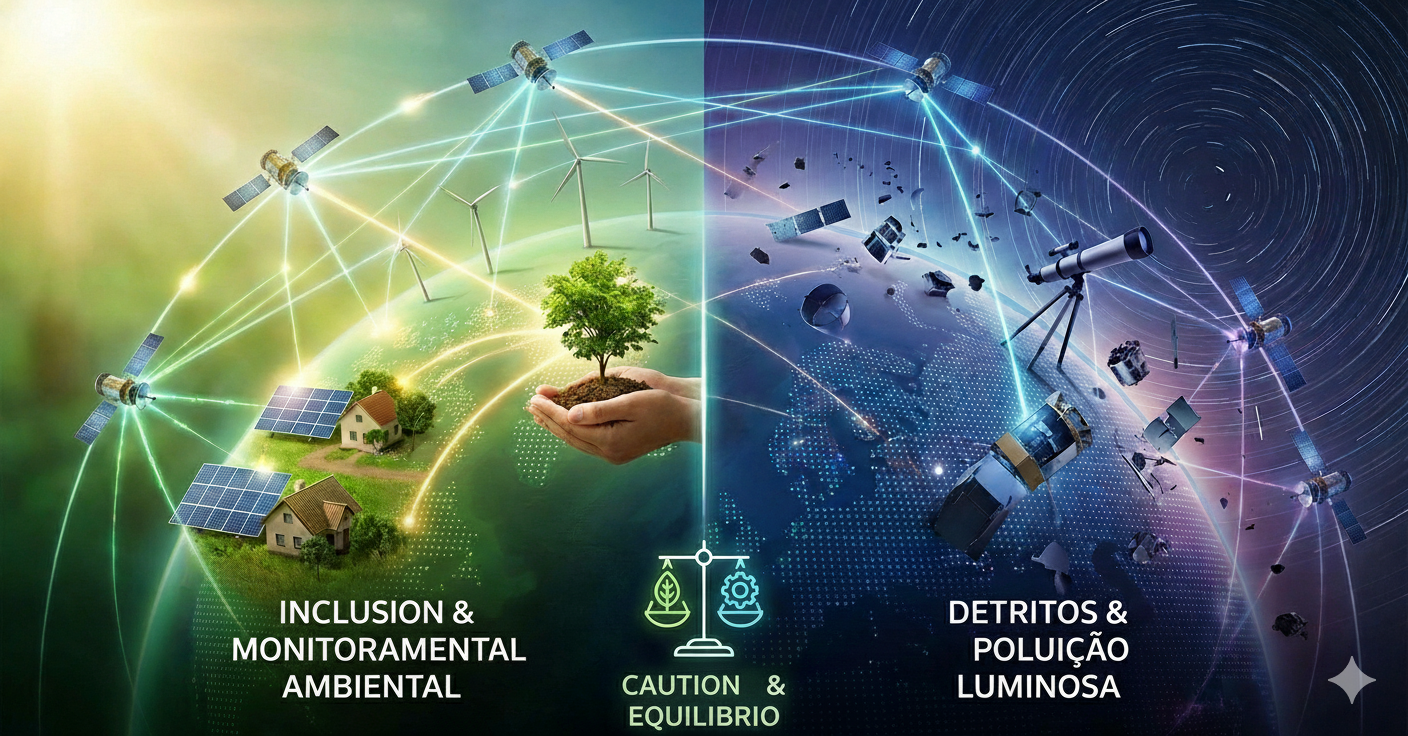
The rapid expansion of satellite internet services has brought unprecedented connectivity to remote regions worldwide, bridging digital divides and enabling economic opportunities previously unimaginable. However, this technological revolution raises important questions about environmental sustainability, space resource management, and the long-term consequences of deploying thousands of satellites in Earth’s orbit. As humanity becomes increasingly dependent on space-based infrastructure, understanding the environmental impacts and implementing responsible practices becomes essential for ensuring that today’s connectivity solutions do not create tomorrow’s environmental crises.
The Promise and the Challenge
Satellite internet represents a powerful tool for sustainable development in many respects. By connecting underserved populations to educational resources, telemedicine, remote work opportunities, and digital financial services, satellite connectivity can reduce poverty and improve quality of life without requiring extensive terrestrial infrastructure development. Rural communities can access the digital economy without the environmental impact of constructing thousands of miles of fiber optic cables or cellular towers across pristine landscapes.
Yet this promise comes with environmental considerations that deserve careful examination. The manufacturing, launching, operating, and eventual disposal of satellites involve resource consumption, energy use, and potential environmental impacts across multiple domains. Understanding these impacts holistically, from manufacturing facilities to orbital debris fields, provides the foundation for developing more sustainable satellite internet systems.
Manufacturing and Resource Consumption
The environmental footprint of satellite internet begins long before any satellite reaches orbit. Manufacturing satellites requires extracting and processing various metals, rare earth elements, and other materials with significant environmental costs. Modern satellites incorporate aluminum, titanium, copper, and specialized composites, all of which require energy-intensive mining, refining, and manufacturing processes.
Rare earth elements used in satellite electronics and solar panels present particular sustainability challenges. These materials, despite their name, are not necessarily rare but are difficult and environmentally damaging to extract and process. Mining operations can create toxic waste, contaminate water supplies, and disrupt local ecosystems. The concentrated geographic distribution of rare earth mining, with significant production occurring in regions with varying environmental regulations, raises concerns about supply chain sustainability.
Solar panels that power satellites require silicon, silver, and other materials with their own environmental production costs. While solar power represents clean energy once operational, manufacturing photovoltaic cells involves toxic chemicals and significant energy consumption. The industry has made progress in reducing manufacturing impacts, but producing thousands of satellites for mega-constellations multiplies these concerns.
Some satellite manufacturers have begun implementing more sustainable production practices. These include using recycled materials where possible, optimizing designs to minimize material requirements, improving manufacturing energy efficiency, and selecting suppliers with strong environmental practices. However, transparency about manufacturing environmental impacts remains limited, making it difficult for consumers and policymakers to assess the true sustainability credentials of different satellite internet providers.
Launch Environmental Impacts
Launching satellites into orbit requires massive amounts of energy and produces various emissions depending on the propellant chemistry used. Traditional rocket propellants include combinations like kerosene and liquid oxygen or solid rocket fuel containing ammonium perchlorate. These propellants release carbon dioxide, water vapor, black carbon, aluminum oxide particles, and other substances into the atmosphere during launches.
The atmospheric impacts of rocket launches occur at various altitudes. Lower atmosphere emissions contribute to local air quality issues near launch sites. Emissions in the stratosphere can affect ozone chemistry, though the scale of current launch activity produces relatively modest impacts compared to other human activities. Water vapor and particles injected at high altitudes can influence atmospheric chemistry in ways scientists are still working to fully understand.
Carbon dioxide emissions from rocket launches, while individually significant, represent a tiny fraction of global emissions when compared to aviation, shipping, or ground transportation. A typical rocket launch might produce emissions equivalent to flying a commercial airliner for several hours. With current launch rates measured in dozens to hundreds annually worldwide, the direct carbon impact remains manageable. However, proposed mega-constellations requiring thousands of satellites, with potential replacement cycles every five to seven years, could substantially increase launch frequency and cumulative emissions.
Emerging launch technologies may reduce environmental impacts. Reusable rockets, now proven by several companies, eliminate the need to manufacture entirely new boosters for each launch, reducing materials consumption and manufacturing impacts. Methane-oxygen propellants, being developed by several launch providers, burn cleaner than kerosene-based fuels. Electric propulsion for satellite orbit-raising reduces the propellant mass requiring launch. Future possibilities like hydrogen-powered rockets could further reduce emissions, though technical and economic challenges remain.
Launch site environmental impacts extend beyond emissions. Rocket launches produce significant noise that can affect wildlife in surrounding areas. Coastal launch sites may impact marine ecosystems through sound propagation underwater. Launch facilities require substantial infrastructure including roads, buildings, fueling systems, and support equipment, all of which have environmental footprints. Responsible launch providers implement environmental monitoring, protect sensitive habitats, and work to minimize local ecosystem disruptions.
Orbital Operations and Energy Consumption
Once operational in orbit, satellites require ongoing energy to maintain communications, position keeping, thermal management, and onboard systems. Modern satellites generate this power through solar panels, making operational energy effectively renewable. This represents a sustainability advantage compared to terrestrial internet infrastructure requiring continuous electrical power drawn from the grid, which may include fossil fuel sources.
However, the full energy picture must account for ground infrastructure supporting satellite internet. User terminals require electricity to operate, consuming perhaps 50 to 100 watts continuously. Ground stations that connect satellite networks to terrestrial internet infrastructure require substantial power for antenna systems, signal processing, and facility operations. Data centers processing and routing satellite internet traffic consume significant energy. Network operations centers monitoring and controlling satellite constellations add further energy requirements.
Comparing the total energy footprint of satellite internet versus terrestrial alternatives presents complex analytical challenges. Fiber optic networks require manufacturing and installing millions of miles of cable, maintaining powered network equipment throughout the infrastructure, and operating data centers. Cellular networks need towers, base stations, and backhaul connections, all consuming continuous power. Satellite systems avoid much of this distributed infrastructure but concentrate environmental impacts in manufacturing, launch, and ground stations.
The calculation changes substantially depending on geographic context. For dense urban areas with existing terrestrial infrastructure, satellite internet likely has a larger environmental footprint per user than fiber or cable service. For remote rural areas where connecting a single home might require miles of new cable installation, satellite internet can represent a more sustainable option by avoiding extensive new infrastructure. Properly assessing sustainability requires considering the specific circumstances and available alternatives.
Space Debris and Orbital Sustainability
Perhaps the most significant long-term sustainability challenge facing satellite internet involves orbital debris and the responsible use of space as a shared resource. Earth’s orbital environment represents a finite resource that all nations and companies must share. The proliferation of satellites, especially in low Earth orbit where most satellite internet constellations operate, raises serious concerns about collision risks, space debris generation, and the long-term sustainability of space activities.
Every satellite launched represents a potential future piece of space debris. Satellites can fail, lose control, or collide with other objects, creating dangerous debris fields. Even tiny particles traveling at orbital velocities carry enormous kinetic energy capable of destroying functional satellites or creating cascading collision events. The Kessler syndrome, a theoretical scenario where increasing debris density triggers runaway collisions that render certain orbits unusable, represents a legitimate concern as satellite populations grow.
Current satellite internet mega-constellations plan to deploy thousands or even tens of thousands of satellites. While individual satellites are designed for relatively short operational lifetimes of five to seven years, the cumulative number of satellites in orbit at any time could exceed all satellites launched throughout history before these projects began. This dramatic increase in orbital population density requires careful management to prevent catastrophic consequences.
Responsible satellite operators implement several debris mitigation measures. Modern satellites include propulsion systems enabling controlled deorbiting at end of life, ensuring they burn up in Earth’s atmosphere rather than remaining as debris. Design practices minimize the likelihood of explosions or fragmentation events. Collision avoidance systems track orbital objects and maneuver satellites to prevent impacts. Orbital slot coordination reduces congestion in heavily used orbital regions.
International guidelines for space debris mitigation, developed through organizations like the United Nations Committee on the Peaceful Uses of Outer Space, provide frameworks for responsible behavior. These guidelines recommend deorbiting satellites within 25 years of mission completion, designing satellites to minimize debris generation, and avoiding intentional destruction of satellites in orbit. However, these remain voluntary guidelines rather than enforceable regulations, and compliance varies among operators.
The satellite internet industry has generally embraced debris mitigation practices more thoroughly than some other space sectors. Major satellite internet providers have committed to aggressive deorbiting timelines, often promising to remove defunct satellites within months to a few years rather than the 25-year guideline. Advanced collision avoidance systems and transparent orbital data sharing help prevent accidents. Nevertheless, the sheer scale of planned constellations means that even small failure rates could generate significant debris.
Astronomical Impacts and Light Pollution
Satellite internet constellations have created an unexpected sustainability concern related to astronomical observation and humanity’s connection to the night sky. Satellites reflect sunlight, appearing as moving points of light visible from Earth’s surface. With thousands of satellites in low Earth orbit, these reflections increasingly interfere with astronomical observations and alter the appearance of the night sky that has inspired human culture throughout history.
Professional astronomical research faces disruptions from satellite trails appearing in telescope images. Long-exposure photographs necessary for studying distant galaxies, searching for asteroids, or conducting other research increasingly show streaks from satellites passing through the field of view. While software can remove some satellite trails, this processing cannot recover data from objects obscured by satellites. Surveys searching for potentially hazardous asteroids or transient astronomical events face particular challenges since satellites can mask real objects.
The astronomical community has engaged constructively with satellite internet providers to mitigate these impacts. Some providers have developed experimental dark satellite coatings or sun visors that reduce reflectivity. Coordinating satellite orientations to minimize sun reflection angles shows promise. Sharing detailed orbital data allows observatories to schedule sensitive observations when satellites are less likely to interfere. Nevertheless, completely eliminating astronomical impacts from large satellite constellations remains technically challenging.
Light pollution from satellites represents a form of environmental impact often overlooked in sustainability discussions. The night sky constitutes a shared natural resource with cultural, scientific, and aesthetic value. Indigenous cultures, navigational traditions, and astronomical heritage sites depend on dark skies. Amateur astronomers and casual stargazers worldwide face a diminishing view of the cosmos. While individual satellites produce modest impacts, thousands of satellites collectively change the fundamental nature of the night sky experience.
Balancing connectivity benefits against astronomical and cultural impacts requires thoughtful consideration. The millions of people gaining internet access through satellite services experience tangible improvements in education, economic opportunity, and quality of life. Simultaneously, preserving humanity’s ability to study and appreciate the universe represents its own sustainability value. Finding solutions that minimize astronomical impacts while delivering connectivity benefits serves both objectives.
E-Waste and End-of-Life Management
Electronic waste from satellite internet extends beyond the satellites themselves to include user terminals, ground equipment, and related electronics. User terminals containing circuit boards, antennas, power supplies, and other components will eventually require disposal. As technology advances and providers upgrade equipment, older terminals become obsolete, potentially creating significant e-waste streams.
E-waste represents a growing global environmental challenge. Electronic devices contain valuable materials worth recovering but also hazardous substances requiring careful handling. Improper disposal can release heavy metals, flame retardants, and other toxins into environments and water supplies. Recycling electronics requires specialized facilities capable of safely disassembling devices and separating materials, infrastructure that remains inadequate in many regions.
Satellite internet providers bear responsibility for considering end-of-life management throughout product lifecycles. Design choices affect recyclability, with modular designs enabling easier component separation and material recovery. Take-back programs that accept obsolete equipment from customers ensure proper disposal and recycling. Extended producer responsibility frameworks, increasingly common in environmental regulation, hold manufacturers accountable for products throughout their entire lifecycles including disposal.
Some forward-thinking approaches include designing user terminals for repairability and upgradeability rather than complete replacement. If core electronics can be updated while preserving antennas and housings, overall material consumption decreases. Refurbishing and redeploying used equipment extends product lifetimes. These circular economy principles reduce environmental impacts while potentially lowering costs for providers and customers.
Comparative Sustainability: Satellite versus Terrestrial Infrastructure
Fairly comparing the sustainability of satellite internet versus terrestrial alternatives requires considering numerous factors across different contexts. Neither technology is universally more sustainable; rather, the preferred option depends on geographic circumstances, user density, existing infrastructure, and specific environmental priorities.
In dense urban and suburban areas with existing fiber optic or cable infrastructure, these terrestrial options generally present lower environmental impacts per user than satellite internet. The infrastructure already exists, avoiding new manufacturing and launch impacts. Economies of scale mean infrastructure and energy costs distribute across many users. Upgrading capacity often requires relatively modest equipment additions rather than launching entirely new satellites.
For rural and remote areas lacking terrestrial infrastructure, the calculation shifts dramatically. Extending fiber optic cable to isolated communities requires manufacturing miles of cable, excavating trenches or stringing lines on poles, and maintaining powered equipment throughout the network. The environmental cost per connected household becomes substantial. Satellite internet can serve these locations with only a user terminal, potentially representing lower overall environmental impact despite higher per-user energy consumption.
The temporal dimension matters significantly. Terrestrial infrastructure, once built, can serve users for decades with incremental upgrades and maintenance. Satellite constellations require periodic replacement as individual satellites reach end of life, creating ongoing manufacturing and launch impacts. Over sufficiently long timescales, the cumulative environmental cost of satellite replacement cycles may exceed initial terrestrial infrastructure deployment.
Emerging technologies may alter these equations. Advances in terrestrial wireless technologies could reduce infrastructure requirements for rural connectivity. More sustainable satellite manufacturing, reusable launch systems, and extended satellite lifetimes could reduce satellite internet environmental impacts. Energy grid decarbonization benefits terrestrial infrastructure more directly than satellite systems. These evolving factors mean sustainability comparisons require periodic reassessment.
Pathways to Greater Sustainability
Improving the sustainability of satellite internet requires action across multiple dimensions, from technical innovation to regulatory frameworks to industry practices. Several promising pathways could significantly reduce environmental impacts while preserving connectivity benefits.
Technical innovations in satellite design offer substantial opportunities. Longer-lived satellites reduce replacement frequency and associated manufacturing and launch impacts. More efficient solar panels and electronics reduce mass and material requirements. Improved propulsion systems enable better orbital management and more reliable end-of-life disposal. Modular satellite designs that enable in-orbit servicing could extend lifetimes and reduce waste.
Manufacturing sustainability improvements include using recycled materials, renewable energy in production facilities, and closed-loop processes that minimize waste. Supply chain transparency allows identifying and addressing environmental hotspots. Standardizing components across satellite generations reduces development waste and enables more efficient production.
Launch sustainability continues advancing through reusable rocket technology, cleaner propellants, and potentially revolutionary concepts like air-launched systems or future space elevators. Optimizing satellite packing and launch scheduling maximizes payload efficiency. Coordinating satellite deployments among providers could reduce total launch requirements.
Regulatory frameworks must evolve to address space sustainability explicitly. Binding international agreements on orbital debris mitigation, deorbiting requirements, and collision avoidance standards would establish baseline practices. Economic incentives like orbital use fees could encourage responsible behavior and fund debris removal. Environmental impact assessments for large satellite constellations could identify concerns early in planning processes.
Industry best practices and voluntary commitments demonstrate leadership while regulations develop. Transparency about environmental impacts enables informed consumer choices and stakeholder pressure. Investing in debris removal technologies and dark sky preservation shows commitment beyond minimum compliance. Collaborative approaches engaging astronomers, environmentalists, and other stakeholders build trust and identify solutions.
The Role of Users and Policy
Individuals choosing satellite internet services can support sustainability through informed decision-making and responsible practices. When terrestrial alternatives exist with lower environmental impacts, choosing those options supports sustainability. When satellite internet represents the only viable option, selecting providers with strong environmental commitments and transparency encourages responsible industry practices.
Users can minimize their own impacts through efficient equipment use, proper disposal of obsolete terminals, and consideration of data consumption patterns. While individual actions have modest impacts, collective behavior shapes industry practices and demonstrates demand for sustainability.
Policymakers face complex decisions balancing connectivity benefits, economic development, environmental protection, and international cooperation. Effective policy requires technical expertise, stakeholder engagement, and willingness to adapt as technologies and understanding evolve. Policies must account for different national circumstances while recognizing that orbital space represents a shared global resource requiring coordinated management.
Balancing Progress and Responsibility
Satellite internet delivers genuine sustainability benefits by connecting underserved populations to opportunities for education, economic participation, healthcare access, and improved quality of life without requiring extensive terrestrial infrastructure. These benefits contribute to several United Nations Sustainable Development Goals including poverty reduction, quality education, decent work and economic growth, and reduced inequalities.
Simultaneously, satellite internet creates environmental challenges including resource consumption, launch emissions, orbital debris risks, and astronomical impacts that require serious attention and ongoing mitigation efforts. Neither dismissing these concerns nor rejecting satellite internet entirely serves sustainability goals effectively.
The path forward requires acknowledging both benefits and impacts honestly, continuing technical innovation to reduce environmental footprints, developing regulatory frameworks that encourage responsible practices, and maintaining transparency that enables informed decisions by users, policymakers, and stakeholders. Satellite internet can be part of sustainable development pathways if pursued thoughtfully with genuine commitment to minimizing environmental harm.
As humanity’s relationship with space evolves from occasional exploration to routine infrastructure operations, establishing sustainable practices now shapes whether space remains accessible and useful for future generations. Satellite internet represents just one application of space technology, but the precedents established by how this industry addresses sustainability challenges will influence space activities broadly. Getting this balance right matters profoundly for both terrestrial connectivity and the long-term sustainability of space as a resource for all humanity.